 Marketing Team

Introduction
Hiring decisions rarely rely solely on resumes and interviews. While candidates may present strong qualifications on paper, these initial assessments do not always provide a complete or fully accurate picture. Often, gaps or inconsistencies only emerge at a later stage of the evaluation process, making an employment background check a critical component of modern hiring.
During these checks, employers often encounter two types of findings: discrepancies and background check red flags. While people often use these terms interchangeably, they mean very different things. A discrepancy might be a simple typo, whereas a red flag can indicate a bigger behavioural risk.
In the fast-evolving hiring landscape of 2026, the ability to distinguish between a factual error and a warning sign is essential. Identifying these red flags correctly allows employers to move beyond basic verification and approach hiring decisions with greater clarity, consistency, and confidence.
Understanding Background Check Red Flags: A Layer Beyond Verification
Before we go deeper, it’s important to redefine how red flags work. In background checks, red flags are not isolated issues but signals that require careful interpretation.
They are often identified through patterns and context rather than a single data point, and their significance depends on the role and nature of the discrepancy. Without proper context, even minor inconsistencies can be misjudged.
Red flags are:
- Often pattern-based indicators
- Context-dependent signals
- Early warnings of potential risk
At the same time, it is equally important to clarify what red flags do not represent.
Red flags are not:
- Automatic grounds for rejection
- Always intentional fraud
- Always identifiable through a single check
Red Flags vs. Discrepancies: Understanding the Key Difference
Before we go deeper, it is important to distinguish between discrepancies and red flags, as both play different roles in the background verification process.
| Aspect | Discrepancy | Red Flag |
|---|---|---|
| Definition | A mismatch in factual information | A potential concern or risk indicator |
| Nature | Objective and data-based | Interpretational and context-driven |
| Focus | Accuracy of information | Meaning and implications of patterns |
| Example | Incorrect joining date | Pattern of frequent short-term employment |
| Occurrence | Usually isolated | Often emerges from repeated patterns |
| Resolution | Requires correction or clarification | Requires deeper evaluation and analysis |
| Outcome | Can typically be resolved with documents | May influence hiring decisions based on risk assessment |
In simple terms:
A discrepancy asks: “Is this information accurate?”
A red flag asks: “What does this indicate?”
Types of Red Flags Across Background Checks
In 2026, background verification is no longer limited to validating data points; it focuses on identifying patterns, behavioural signals, and risk indicators across multiple checks. Red flags are evaluated not in isolation, but as part of a broader risk narrative.
Below is an expanded classification of background check red flags across key verification areas:
Address Check
- Non-Existent Address: The provided address cannot be found in official records or verified physically, which strongly indicates a potentially fabricated identity (e.g., an invalid building name, not listed in the Hong Kong Rating and Valuation Department database, or not traceable during field verification in Hong Kong).
- No Residency Proof: Independent checks with relevant sources, such as building management, security, or property records, confirm that the candidate has never resided at the declared address, raising concerns of false declaration (e.g., estate management records in Hong Kong show a different registered occupant for the flat).
- ID-Address Mismatch: The address associated with the candidate’s identity records does not align with the declared residential address, absent a valid justification, suggesting inconsistency or possible manipulation (e.g., Hong Kong Identity Card-linked records indicate Kowloon, while the candidate claims residence in Hong Kong Island with no supporting proof).
- Proof Not Provided: The candidate is unable or unwilling to submit standard address verification documents such as utility bills or tenancy agreements, indicating possible concealment of actual residence (e.g., repeated delays in providing bills from CLP Power Hong Kong or a signed tenancy agreement).
- Frequent Relocations: Multiple changes in residential addresses within a short period without clear or logical reasons may indicate instability or an attempt to avoid traceability (e.g., frequent movement across Hong Kong districts within a year without corresponding employment or lifestyle changes).
Adverse Media Check
- Fraud/Crime Linkage: The candidate is associated with media reports involving fraud or criminal activity, which raises serious concerns about integrity and potential legal exposure (e.g., named in a financial scam reported by Hong Kong news platforms or covered in public records).
- Negative Media Coverage: Publicly available articles highlight misconduct or unethical behavior, indicating reputational risk for the organization (e.g., news reports in Hong Kong covering a workplace harassment case involving the candidate).
- High-Risk Associations: The candidate is linked to individuals or entities involved in suspicious or unlawful activities, suggesting indirect exposure to risk (e.g., business partner under investigation by Hong Kong authorities).
- Regulatory Violations: Media references indicate breaches of laws or compliance standards, raising concerns about adherence to regulatory requirements (e.g., fined or investigated by the Securities and Futures Commission in Hong Kong).
- Repeated Mentions: Multiple negative media records over time suggest a pattern of concerning behavior rather than an isolated incident (e.g., recurring legal disputes involving the candidate reported across Hong Kong news sources).
Bankruptcy Check
- Current Bankruptcy Status: The candidate is currently declared bankrupt under applicable laws, indicating significant financial instability and potential risk in handling financial responsibilities (e.g., listed as an undischarged bankrupt in records maintained by the Official Receiver’s Office in Hong Kong).
- Undisclosed Bankruptcy Record: Bankruptcy status appears in official records but was not disclosed by the candidate, suggesting a lack of transparency and possible intentional omission (e.g., insolvency record found in Hong Kong public registers but not declared during background screening).
- Multiple Insolvency Filings: Repeated bankruptcy filings indicate a pattern of financial mismanagement and ongoing instability (e.g., more than one bankruptcy record found in Hong Kong court or insolvency databases).
- Bankruptcy-Related Legal Restrictions: Legal limitations imposed due to bankruptcy may restrict financial or managerial responsibilities, posing a compliance and governance risk (e.g., disqualified from acting as a company director under Hong Kong insolvency regulations).
- Ongoing Insolvency Proceedings: The bankruptcy or financial recovery process is still active with unresolved obligations, indicating continued financial risk (e.g., pending creditor claims or undischarged status in Hong Kong insolvency proceedings).
Civil Litigation Check
- Involvement in Significant Legal Disputes: The candidate is involved in major civil litigation matters, which may indicate potential legal, financial, or reputational risk (e.g., high-value contract dispute or fraud-related case filed in Hong Kong courts).
- Litigation Related to Fraud or Misconduct: The candidate is directly linked to legal cases involving dishonesty, misrepresentation, or unethical conduct, raising serious integrity concerns (e.g., a civil case related to financial misrepresentation or cheating filed in Hong Kong).
- History of Multiple Legal Proceedings: Frequent involvement in civil cases suggests a pattern of disputes or non-compliance, which may impact reliability and professional conduct (e.g., multiple lawsuits registered across different Hong Kong courts over time).
- Adverse Court Judgments: Court rulings have been made against the candidate, indicating proven liability or unfavorable legal outcomes (e.g., ordered to pay damages or penalties in a Hong Kong civil case).
- Undisclosed Legal Matters: Existing or past litigation has not been disclosed by the candidate, raising concerns about transparency and completeness of information (e.g., an active case in Hong Kong courts was omitted during background verification).
Credit Check
- Loan Repayment Defaults: The candidate has failed to meet loan repayment obligations, indicating financial instability and potential risk in roles involving financial responsibility (e.g., overdue credit facilities or missed repayments reported by TransUnion Hong Kong).
- Low Creditworthiness Score: A below-threshold credit score reflects poor financial discipline and may indicate challenges in managing financial commitments (e.g., low credit rating recorded in Hong Kong credit reports).
- High Debt Exposure: Excessive financial liabilities relative to income suggest financial stress and potential vulnerability to risk (e.g., multiple active loans or high outstanding balances reflected in Hong Kong credit data).
- Settlements or Debt Write-offs: Debts settled for reduced amounts or written off indicate compromised repayment behavior and possible financial distress (e.g., partial loan settlements recorded in Hong Kong credit history).
- Consistent Payment Delays: Repeated late payments demonstrate unreliable financial behavior and weak credit management practices (e.g., frequent credit card payment delays reported in Hong Kong credit records).
Criminal Record Check
- Confirmed Criminal Convictions: The candidate has been found guilty in a court of law, indicating serious legal and integrity concerns that may affect suitability for employment (e.g., a conviction for theft or fraud recorded in Hong Kong court or law enforcement records).
- Ongoing Criminal Proceedings: The candidate is currently involved in an active criminal case, creating potential legal uncertainty and future risk exposure (e.g., case under trial in Hong Kong courts).
- Involvement in Serious Offenses: The candidate is linked to major criminal activities, raising significant concerns regarding conduct, safety, and trustworthiness (e.g., involvement in assault, fraud, or similar offenses reported in Hong Kong).
- Pattern of Repeated Offenses: Multiple criminal records indicate a recurring pattern of unlawful behavior, suggesting heightened risk (e.g., repeated offenses documented in Hong Kong law enforcement databases).
- Undisclosed Criminal History: The candidate has not disclosed any existing or past criminal records, raising concerns about transparency and honesty (e.g., a prior conviction in Hong Kong not declared during background verification).
CV Check
- Unverifiable Employment History: The candidate has listed work experience that cannot be validated with the stated employer, indicating possible fabrication of employment details (e.g., a Hong Kong-based company has no record of the candidate’s employment).
- Inflated Job Title or Responsibilities: The candidate has overstated their designation or role, suggesting misrepresentation of actual responsibilities and seniority (e.g., claims a managerial role in a Hong Kong organization but records indicate an entry-level position).
- Unverified Academic Qualifications: Educational credentials provided cannot be authenticated, raising concerns about the legitimacy of qualifications (e.g., degree not issued or not verifiable with a Hong Kong institution or recognized body).
- Unexplained Employment Gaps: Significant gaps in employment history are not disclosed or justified, which may indicate undisclosed activities or inconsistencies (e.g., unexplained gap while residing or working in Hong Kong).
- Unsupported Achievements or Claims: Stated accomplishments, awards, or project contributions lack verifiable evidence, suggesting possible exaggeration or falsification (e.g., claimed achievements in a Hong Kong role cannot be substantiated through records or references).
Declaration of Integrity
- False or Inaccurate Declarations: The candidate has provided incorrect or misleading information in the declaration, raising serious concerns about honesty and integrity (e.g., denies any criminal history despite records in Hong Kong courts indicating a prior conviction).
- Undisclosed Conflicts of Interest: Relevant personal, financial, or professional interests that could influence decision-making have not been disclosed, indicating a lack of transparency (e.g., ownership or stake in a Hong Kong-based vendor company not declared).
- Intentional Misrepresentation of Information: Key details have been deliberately altered or misrepresented, suggesting an attempt to mislead or conceal facts (e.g., inaccurate employment details related to a Hong Kong organization provided in the declaration).
- Refusal to Provide Formal Declaration: The candidate declines or avoids signing the integrity declaration, indicating reluctance to be held accountable for the accuracy of provided information (e.g., refusal to submit a signed declaration form as part of Hong Kong onboarding requirements).
- Incomplete Disclosure of Critical Information: Important sections of the declaration are left blank or partially filled, raising concerns about omission of relevant details (e.g., failure to disclose prior legal matters in Hong Kong despite mandatory declaration fields).
Directorship Check
- Undisclosed Directorship Roles: The candidate has failed to disclose active or past directorship positions, raising concerns about transparency and potential conflicts (e.g., listed as a director in the Hong Kong Companies Registry but not declared).
- Association with Deregistered or Struck-off Entities: The candidate is linked to companies that have been removed or deregistered by authorities, which may indicate involvement in non-compliant or inactive businesses (e.g., directorship in a Hong Kong company struck off by the Companies Registry).
- Involvement in Shell or Non-operational Companies: The candidate is associated with entities that lack legitimate business activity, raising concerns about financial or regulatory risks (e.g., connection to a Hong Kong company with no active operations or filings).
- Disqualified Director Status: The candidate has been legally restricted or disqualified from holding directorship positions, indicating serious compliance concerns (e.g., disqualification recorded under Hong Kong regulatory or court directives).
- Multiple High-Risk Business Associations: The candidate is linked to several companies with unstable or adverse records, suggesting a pattern of risky business involvement (e.g., multiple Hong Kong-based companies with financial or compliance issues).
Driver’s License Check
- Unverifiable Licence: The driving licence provided cannot be verified in official records, raising concerns about authenticity (e.g., licence number not found in Hong Kong Transport Department records).
- Revoked Driving Privileges: The candidate’s driving rights have been temporarily or permanently withdrawn due to violations, indicating compliance and safety concerns (e.g., licence suspension recorded in Hong Kong due to traffic offenses).
- Fraudulent Licence Document: The submitted licence appears to be altered, duplicated, or entirely fabricated, indicating potential document fraud (e.g., tampered Hong Kong driving licence or inconsistencies in official format).
- History of Serious Driving Offenses: The candidate has been involved in major traffic violations, raising concerns about responsibility and adherence to regulations (e.g., record of dangerous driving or driving under the influence in Hong Kong).
- Use of Expired Licence: An outdated licence has been submitted, indicating non-compliance with legal validity requirements (e.g., a Hong Kong driving licence expired but was presented as valid proof).
Employment Verification
- Unverifiable Employment Record: The claimed employment cannot be validated with the stated employer, indicating possible fabrication or misrepresentation of work history (e.g., HR of a Hong Kong-based company confirms no record of the candidate’s employment).
- Fake Employer: The organization listed by the candidate is not a legitimate or registered entity, raising concerns about the authenticity of the employment claim (e.g., company not found in the Hong Kong Companies Registry or identified as a shell entity).
- Inflated Job Title: The candidate has overstated their designation or role, suggesting misrepresentation of experience and seniority (e.g., claims Team Lead role in a Hong Kong firm, but records indicate an Associate position).
- Undisclosed Exit Reason: The reason for leaving previous employment has been concealed or inaccurately stated, indicating potential integrity concerns (e.g., termination due to misconduct in a Hong Kong company not disclosed).
- Non-genuine References: References provided by the candidate are unreliable, fabricated, or influenced, raising concerns about credibility (e.g., reference contact in Hong Kong identified as a personal acquaintance posing as a reporting manager).
Education Verification
- Invalid Degree: The claimed academic qualification was never awarded, indicating potential falsification of educational credentials (e.g., degree not issued by the stated Hong Kong university or institution).
- Unrecognized Institution: The institution attended is not recognized by relevant regulatory or accreditation bodies, raising concerns about the legitimacy of the qualification (e.g., institute not listed with the Hong Kong Education Bureau or relevant authority).
- Tampered Academic Documents: Submitted academic records show signs of alteration or manipulation, indicating possible document fraud (e.g., edited marksheet or certificate from a Hong Kong institution).
- Incomplete Education: The candidate has claimed completion of a program that was not fully completed, suggesting misrepresentation of qualifications (e.g., dropping out of a Hong Kong college claiming full graduation).
- Association with Blacklisted: The qualification is linked to institutions known for fraudulent practices or listed as high-risk, raising serious credibility concerns (e.g., institution flagged by Hong Kong authorities or global education watchdogs).
Financial Regulatory Check
- Regulatory Non-Compliance or Violations: The candidate has been involved in breaches of financial laws or regulatory requirements, indicating potential compliance and integrity risks (e.g., fined or penalized by the Hong Kong Securities and Futures Commission (SFC) or Hong Kong Monetary Authority (HKMA)).
- Revocation or Suspension of Financial Licences: The candidate’s authorization to operate in regulated financial activities has been revoked or suspended, raising concerns about professional conduct (e.g., licence withdrawn or suspended by the SFC in Hong Kong).
- Blacklisting or Adverse Regulatory Listing: The candidate has been identified by regulatory authorities as non-compliant or high-risk, impacting credibility and employability (e.g., listed on warning or disciplinary lists published by Hong Kong regulators such as the SFC).
- Penalties for Fraud or Financial Misconduct: The candidate has been penalized for involvement in fraudulent or unethical financial activities, indicating serious integrity concerns (e.g., fined for insider dealing or market misconduct under Hong Kong regulations).
- Undisclosed Regulatory Actions: Past or ongoing regulatory actions have not been disclosed by the candidate, raising concerns about transparency and honesty (e.g., previous disciplinary action by a Hong Kong financial authority not declared during screening).
Global Sanctions & PEP Check
- Match with Sanctioned Individual Lists: The candidate appears on international sanctions lists, indicating legal and compliance risks that may restrict business or employment engagement (e.g., listed on United Nations (UN), OFAC, or Hong Kong-relevant sanctions screening databases monitored by financial institutions).
- Politically Exposed Person (PEP) Status: The candidate holds or is closely associated with a prominent public position, increasing exposure to potential corruption or bribery risks (e.g., current or former Hong Kong government official, or immediate family member of a senior public office holder).
- Association with Sanctioned Entities: The candidate is linked to organizations or businesses that are subject to sanctions, raising concerns about indirect compliance risks (e.g., involvement with a company operating in Hong Kong that is connected to a globally sanctioned entity).
- Compliance Database Match: The candidate appears in international compliance or risk databases, indicating potential concerns that require further due diligence (e.g., flagged in global screening tools used by Hong Kong financial institutions for AML/KYC checks).
- Undisclosed Political Exposure: The candidate has not declared their politically exposed status or affiliations, raising concerns about transparency and regulatory compliance (e.g., indirect political connections in Hong Kong not disclosed during background screening).
ID Check
- Forged or Fraudulent Identity Document: The identity document provided appears to be fabricated or not issued by an authorized authority, raising serious concerns about authenticity and identity fraud (e.g., fake or digitally altered Hong Kong Identity Card (HKID) or passport not matching official formats).
- Multiple or Conflicting Identities: Different identity documents present inconsistent personal details, suggesting possible identity manipulation or duplication (e.g., name or identification number mismatch across Hong Kong-issued documents such as HKID and passport).
- Tampered or Altered Document: The submitted ID shows signs of modification, such as changes to key fields, indicating potential document manipulation (e.g., altered photo or edited details on a Hong Kong Identity Card).
- Use of Expired or Invalid Identification: An identity document that is no longer valid has been submitted, indicating non-compliance with verification requirements (e.g., expired Hong Kong passport or outdated identification document presented as valid proof).
- Mismatch in Personal Data Across Documents: Critical personal information does not align across submitted documents, raising concerns about accuracy and credibility (e.g., date of birth or name discrepancies across Hong Kong-issued identity records).
Insurance Agent Check
- Blacklisted Status: The individual appears on internal or regulatory watchlists, indicating prior concerns related to conduct or compliance (e.g., flagged by the Hong Kong Insurance Authority (IA) or listed in industry warning records).
- Cancelled Licence: The agent’s authorization to operate has been withdrawn due to violations or misconduct, raising serious professional integrity concerns (e.g., licence revoked by the Hong Kong Insurance Authority).
- Involvement in Insurance Fraud: The individual is linked to fraudulent insurance activities, indicating high risk and unethical conduct (e.g., involvement in false claims or policy manipulation cases reported in Hong Kong).
- Customer Complaints: Repeated complaints or evidence of unethical sales practices suggest potential risk to customers and organizations (e.g., complaints lodged with the Hong Kong Insurance Authority regarding misleading policy sales).
- Undisclosed Disciplinary Actions: Past regulatory or disciplinary actions have not been declared, raising concerns about transparency and trustworthiness (e.g., prior suspension by the Hong Kong Insurance Authority not disclosed).
Insurance Regulatory Check
- Regulatory Non-Compliance: The entity or individual has breached insurance laws or regulatory requirements, indicating compliance risks (e.g., fined or penalized by the Hong Kong Insurance Authority for non-compliance).
- Suspension of Licence: Authorization to operate has been temporarily restricted due to regulatory issues, affecting credibility and reliability (e.g., licence suspended by the Hong Kong Insurance Authority).
- Imposition of Financial: Regulatory authorities have taken enforcement action, including fines or sanctions, reflecting misconduct or non-compliance (e.g., financial penalty imposed by the Hong Kong Insurance Authority).
- Pattern of Repeated Non-Compliance: Multiple instances of violations suggest ongoing disregard for regulatory standards (e.g., repeated warnings or actions issued by Hong Kong insurance regulators).
- Undisclosed Regulatory Issues: The candidate or entity has failed to disclose past or ongoing regulatory actions, raising concerns about integrity (e.g., previous penalties by the Hong Kong Insurance Authority not declared).
Passport Check
- Fraudulent Passport: The passport provided appears to be fake or not issued by an authorized authority, indicating potential identity fraud (e.g., counterfeit Hong Kong SAR passport or inconsistencies with Immigration Department records).
- Restricted Passport Status: The passport is flagged in immigration or security systems, indicating travel restrictions or legal concerns (e.g., listed in the Hong Kong Immigration Department or international watchlists).
- Tampered or Altered Passport: The document shows signs of modification, suggesting manipulation of identity or travel details (e.g., altered photo or data page in a Hong Kong-issued passport).
Multiple or Conflicting Passports: The presence of more than one passport with inconsistent details raises concerns about identity discrepancies (e.g., conflicting personal details across passports used in Hong Kong immigration records).
- Use of Expired Passport: An expired passport has been submitted, indicating non-compliance with document validity requirements (e.g., an expired Hong Kong SAR passport presented as valid identification).
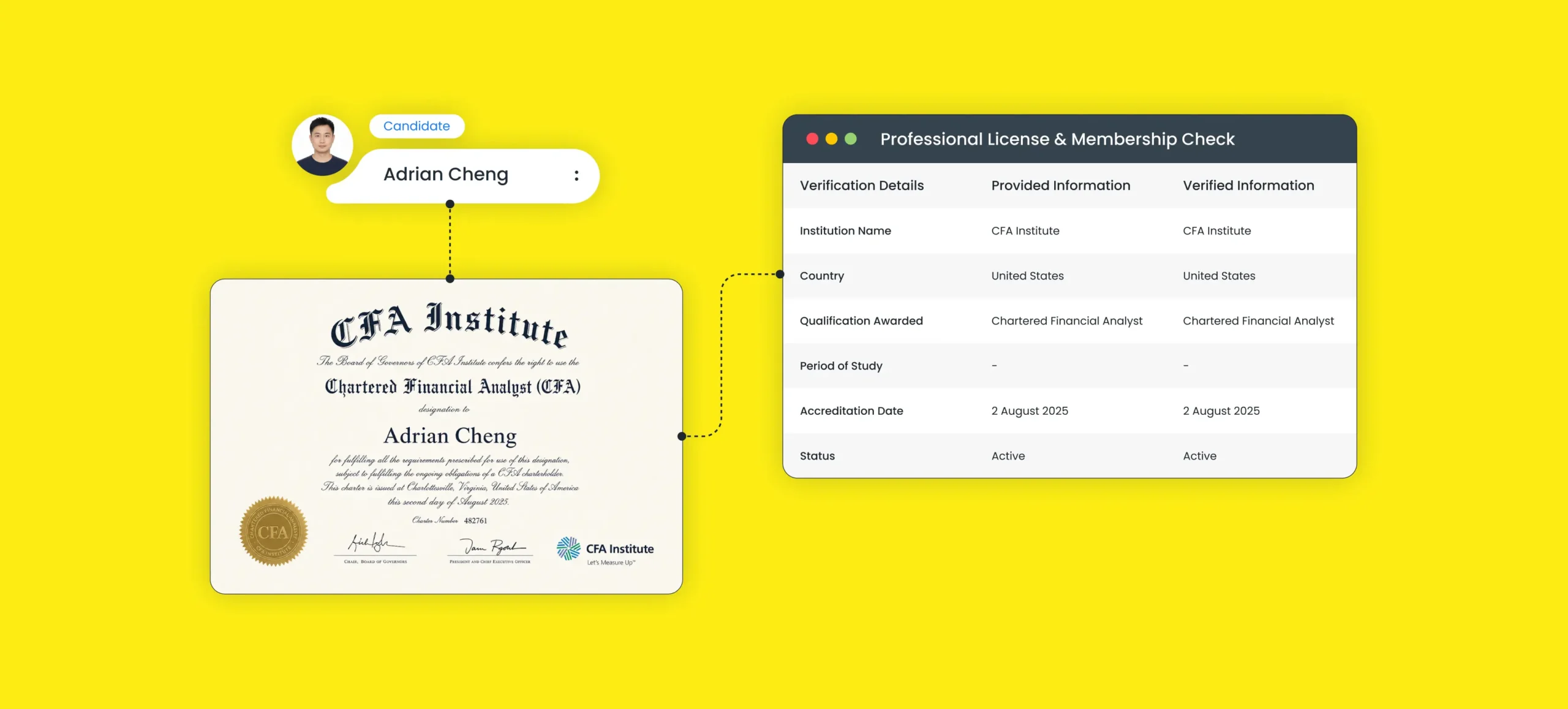
Professional License & Membership Check
- Invalid or Unverifiable Licence: The professional licence cannot be validated with the issuing authority, indicating possible misrepresentation (e.g., licence number not found with the Hong Kong Medical Council, Law Society, or relevant body).
- Withdrawn Certification: The individual’s licence or certification has been cancelled due to misconduct or regulatory violations (e.g., licence revoked by a Hong Kong professional regulatory body).
- Misleading Membership Claims: The candidate has claimed association with professional bodies that cannot be verified, raising credibility concerns (e.g., not listed as a member of a recognized Hong Kong professional association).
- Expired Certification: The licence or membership is no longer valid due to non-renewal, indicating non-compliance with professional standards (e.g., expired practising certificate issued by a Hong Kong regulatory authority).
- Disciplinary Actions by Governing Bodies: The individual has been subject to disciplinary measures, indicating potential professional misconduct (e.g., suspension or sanctions imposed by a Hong Kong professional council).
Reference Check
- Negative Feedback from Referees: Feedback obtained from references highlights concerns regarding the candidate’s performance, conduct, or reliability, indicating potential workplace risks (e.g., a former manager at a Hong Kong-based company reports issues related to misconduct or poor performance).
- Non-genuine Reference: The provided referee cannot be verified as a legitimate professional contact, suggesting possible manipulation of the reference process (e.g., a reference in Hong Kong identified as a personal acquaintance posing as a reporting manager).
- Inability to Verify Employment Details: The referee or organization declines to confirm the candidate’s employment or provide relevant details, raising concerns about authenticity (e.g., HR of a Hong Kong employer refuses to validate employment information).
- Contradictory Feedback: Information provided by references does not align with the candidate’s declared details, indicating discrepancies that require further investigation (e.g., job role or responsibilities in a Hong Kong company differ from those stated in the CV).
- Coordinated Responses: Responses from referees appear overly rehearsed or identical, suggesting possible coaching or lack of authenticity (e.g., multiple references from Hong Kong contacts provide identical wording or structured answers).
Right to Work Check
- Lack of Valid Work Authorization: The candidate does not possess the legal right to work in the jurisdiction, posing significant compliance and legal risks for the employer (e.g., no valid employment visa or work authorization issued by the Hong Kong Immigration Department).
- Expired Work Permit: The candidate’s work authorization is no longer valid, indicating non-compliance with immigration requirements (e.g., Hong Kong employment visa expired without renewal).
- Fraudulent Work Documents: Submitted work authorization documents appear to be falsified or altered, raising serious concerns about authenticity (e.g., edited or fake Hong Kong visa or entry permit).
- Restricted Work Conditions: The candidate’s visa or permit includes limitations that restrict employment type or hours, which may not align with job requirements (e.g., a Hong Kong student visa with limited work permissions).
- Visa Issues: Past or ongoing visa-related concerns have not been disclosed, indicating potential transparency issues (e.g., prior Hong Kong visa rejection or cancellation not declared).
Salary Verification Check
- Inflated Compensation Claims: The candidate has overstated their previous or current salary, indicating potential misrepresentation of financial details (e.g., declared salary in a Hong Kong role significantly higher than employer or bank records).
- Non-genuine Salary Documents: Salary slips or financial proofs appear fabricated or altered, raising concerns about document authenticity (e.g., edited payslips from a Hong Kong employer).
- Incomplete Disclosure of Compensation Structure: Key salary components such as bonuses, allowances, or variable pay are not fully disclosed, leading to an inaccurate representation of earnings (e.g., omission of variable pay components in a Hong Kong compensation structure).
- Significant Discrepancies in Financial Records: There is a notable mismatch between declared salary and verified financial data, indicating inconsistencies (e.g., differences between Hong Kong bank statements and declared income).
- Manipulated Financial Documentation: Financial documents show signs of alteration, suggesting deliberate attempts to misrepresent earnings (e.g., edited Hong Kong bank statements or compensation records).
Social Media Check
- Offensive Online Content: The candidate has shared content that is unprofessional or offensive, potentially impacting workplace culture and reputation (e.g., abusive or inappropriate posts visible on social platforms in a Hong Kong context).
- Hate Speech or Discriminatory Views: Content reflects biased or discriminatory opinions, raising serious concerns about inclusivity and conduct (e.g., posts targeting specific communities within Hong Kong).
- Indicators of Illegal Activities Online: Social media activity suggests involvement in or promotion of unlawful behavior, posing legal and reputational risks (e.g., posts indicating illegal activities under Hong Kong law).
- Disclosure of Confidential Information: The candidate has shared proprietary or confidential information publicly, indicating poor judgment and potential compliance breaches (e.g., posting internal details of a Hong Kong employer or client data online).
- Pattern of Concerning Online Behavior: Repeated instances of questionable or controversial online activity suggest consistent behavioral risks (e.g., frequent posting of controversial or problematic content within Hong Kong social media circles).
What Triggers These Red Flags in the First Place
When red flags appear during the employment background check, employers should follow a structured approach. In many cases, these issues stem from gaps in documentation, outdated information, or differences in reporting standards. However, there are also situations where discrepancies may result from deliberate misrepresentation.
Common triggers include:
Intentional Misrepresentation: One of the most common triggers is the deliberate falsification or exaggeration of details by the candidate to improve employability or conceal an unfavorable history. This includes false claims related to identity, employment, education, financial status, or legal background.
Lack of Proper Documentation: Failure to provide valid, complete, or verifiable supporting documents often leads to red flags. This may arise from poor record-keeping, negligence, or an inability to substantiate claims with authentic proof.
Undisclosed Adverse Information: Candidates may intentionally omit critical details such as past legal issues, financial distress, regulatory actions, or employment terminations, which later surface during background verification.
Data Inconsistencies: Discrepancies between declared information and verified records (e.g., documents, databases, references, or public records) are a key trigger. Even minor inconsistencies across identity, employment, or financial data can raise concerns
Association with High-Risk Entities: Links to non-compliant organizations, fraudulent entities, sanctioned individuals, or unethical practices can trigger red flags, even if indirect. These associations increase perceived risk for employers.
The Real Impact of Background Check Red Flags on Hiring Decisions
The presence of background check red flags can influence hiring decisions in several ways. While not all red flags lead to rejection, they often require closer evaluation and may affect how quickly or confidently a hiring decision is made.
Delayed Hiring Process: Red flags often slow down the hiring process as employers take extra time to verify information, request documents, or conduct additional checks. This can impact onboarding timelines and delay critical business operations.
Increased Risk Assessment: Employers assess potential risks related to compliance, financial integrity, data security, and workplace safety, especially for sensitive roles. The level of scrutiny typically increases depending on the responsibility and exposure associated with the position.
Conditional Hiring Decisions: Candidates may still be considered but under specific conditions, such as probation periods, restricted responsibilities, or additional monitoring. This allows employers to balance hiring needs while managing potential risks.
Impact on Candidate Credibility: Even minor discrepancies can raise concerns about a candidate’s honesty or attention to detail. This may influence the employer’s level of trust, especially when consistency is critical.
Ultimately, the impact depends on the relevance and context of the red flag. A structured and balanced approach allows employers to differentiate between minor discrepancies and issues that may pose a genuine risk to the organization.
Responding to Red Flags: What Employers Should Do Next
When red flags arise during an employment background check, employers should adopt a structured, fair, and risk-based approach. These red flags, often triggered by intentional misrepresentation, data inconsistencies, lack of documentation, non-disclosure, or high-risk associations, require careful evaluation before any hiring decision is made. A consistent process not only mitigates risk but also ensures compliance and protects candidate rights.
Key steps employers should follow:
Verify the Information: Confirm that the identified red flag is accurate and not due to administrative errors, outdated records, or incomplete data. Cross-check details across multiple reliable sources or initiate re-verification where necessary.
Engage the Candidate for Clarification: Provide the candidate with an opportunity to explain discrepancies, especially those arising from data inconsistencies or missing documentation. Transparent communication helps distinguish genuine errors from intentional misrepresentation.
Assess the Nature of the Risk: Evaluate the issue based on its severity, frequency, and recency. For example, isolated documentation gaps may be less concerning than repeated non-disclosure, while serious issues such as criminal records or regulatory violations require deeper scrutiny.
Policy & Regulatory Compliance: Ensure all decisions align with internal hiring policies and applicable regulations, including the Personal Data (Privacy) Ordinance. Maintain consistency across candidates to avoid bias, while safeguarding data privacy and ensuring proper handling of sensitive information.
Risk-Based Decision Making: Determine the appropriate outcome, such as proceeding with conditions, requesting additional checks, modifying the role, or declining the candidate. Clearly document findings, rationale, and actions taken, ensuring confidentiality at all stages.
Conclusion
Background check red flags are an inevitable part of the hiring process, but they should not be viewed in isolation. Instead, they should be carefully evaluated within the broader context of a candidate’s profile and the role requirements.
A well-managed employment background check process allows organizations to identify potential risks while maintaining fairness and compliance. By understanding and responding to red flags effectively, employers can make more confident, informed, and balanced hiring decisions.
Not All Red Flags Are Easy to Spot
Enhance your screening process with checks that uncover what others miss.