 Marketing Team
Introduction
Organizations today operate in a highly competitive and regulated hiring environment, making accurate hiring decisions more important than ever. Employers increasingly look beyond resumes and LinkedIn profiles to verify a candidate’s employment history, education, and professional credentials to reduce hiring risks and ensure compliance.
Among these checks, Professional License & Membership Verification has become an essential part of the screening process. It helps employers confirm that a candidate holds a valid and authentic license or membership issued by a recognized authority, and that it remains active and in good standing.
In jurisdictions such as Hong Kong, where sectors like finance, healthcare, and legal services are heavily regulated, professional license verification plays a vital role in maintaining workforce integrity and meeting regulatory requirements.
Defining Professional License & Membership Verification
Professional License & Membership Verification is a screening process that helps employers validate a candidate’s professional credentials. It is used to confirm whether a professional license, registration, certification, or membership with a recognized professional body is authentic, active, and in good standing.
Many professions require individuals to obtain licenses or maintain memberships with regulatory authorities and professional associations before they can legally practice their occupation. During the hiring process, employers verify these credentials to ensure that candidates meet industry standards and possess the qualifications necessary to perform their roles.
This verification typically involves confirming:
- The authenticity of the license or professional membership
- The issuing authority or professional body that granted the credential
- The current status of the credential, including whether it is active, suspended, expired, or revoked
- The candidate’s ownership of the credential
- Any disciplinary actions or restrictions, where applicable
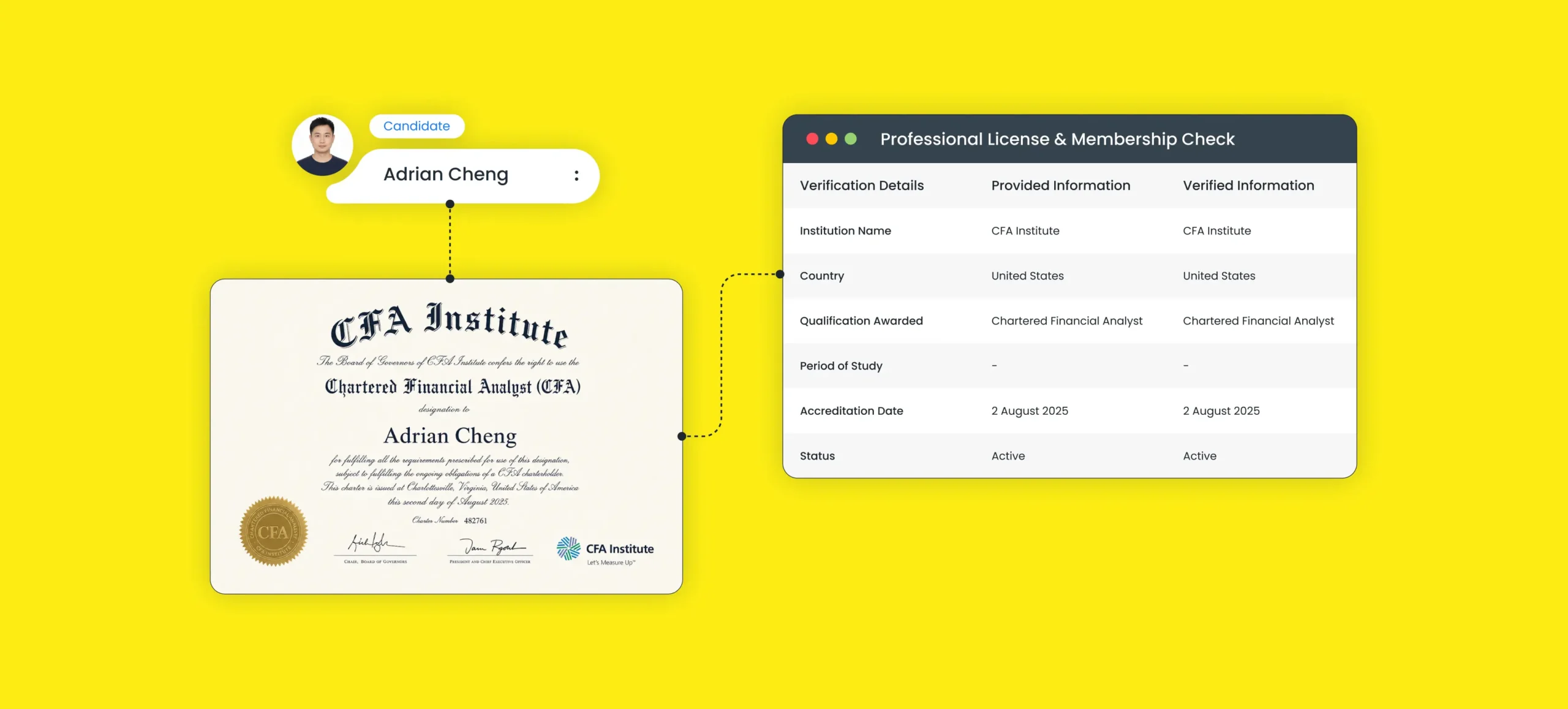
For example, a financial services firm may verify whether a candidate holds a valid Chartered Financial Analyst (CFA) designation and is recognised by the CFA Institute. Employers may also confirm the candidate’s membership status and whether the credential remains active and in good standing. These checks help organisations ensure that candidates possess the professional qualifications they claim while reducing the risk of hiring individuals with misrepresented or invalid credentials.
Why Professional License & Membership Verification Matters in Hiring
When employers hire candidates for specialized or regulated roles, they must ensure that the individual truly holds the qualifications they claim. While resumes and interviews provide an overview of a candidate’s background, they do not always confirm whether professional credentials are genuine, active, and legally valid.
Professional License Verification helps employers bridge this gap by independently validating a candidate’s professional standing before final hiring decisions are made.
This verification is important because it helps employers:
- Ensure candidates meet legal and professional requirements for the role
- Prevent credential fraud, misrepresentation, or outdated claims
- Reduce hiring risks related to compliance failures or unqualified hires
- Build confidence and trust in the hiring decision-making process
- Support regulatory and industry compliance obligations
In regulated industries such as healthcare, finance, legal services, and engineering, hiring without proper verification can lead to serious consequences, including regulatory penalties, reputational damage, and operational risks.
Industries That Commonly Require Professional License & Membership Verification
Not all industries require strict credential verification, but in many regulated and high-responsibility sectors, verifying professional licenses and memberships is a critical part of the hiring process. In these fields, employees are often required to hold valid certifications or registrations before they can legally or ethically perform their duties.
Below are key industries where this verification is commonly required:
Healthcare: Verification of licences and registrations issued by bodies such as the Medical Council of Hong Kong, Nursing Council of Hong Kong, and Pharmacy and Poisons Board of Hong Kong. For example, a hospital hiring a surgeon may verify that the candidate is registered with the Medical Council of Hong Kong and holds a valid practising licence.
Financial Services: Verification of Securities and Futures Commission (SFC) licences, including Type 1 (Dealing in Securities), Type 4 (Advising on Securities), and Type 9 (Asset Management) licences, along with professional credentials such as the Chartered Financial Analyst (CFA) designation. For example, an investment firm may verify that a relationship manager holds a valid SFC Type 4 licence and has obtained the CFA designation to support their professional qualifications and expertise.
Legal Services: Verification of practising status with The Law Society of Hong Kong for solicitors and the Hong Kong Bar Association for barristers. For example, a law firm may confirm that a newly hired solicitor has a current practising certificate and remains in good standing with the Law Society.
Engineering and Construction: Verification of Registered Professional Engineer (RPE) status through the Engineers Registration Board, as well as relevant registrations under the Construction Industry Council (CIC). For example, an engineering consultancy bidding for a government infrastructure project may verify that its lead engineer holds active RPE status.
Education: Verification of recognised teaching qualifications and professional credentials, such as Qualified Teacher Status (QTS), Postgraduate Certificate in Education (PGCE), or other institution-specific teaching licences. For example, an international school may verify that a candidate teaching secondary mathematics holds a valid PGCE and QTS qualification.
Insurance and Compliance: Verification of licences issued by the Insurance Authority (IA) for insurance intermediaries, along with professional certifications such as Certified Anti-Money Laundering Specialist (CAMS) and memberships with the International Compliance Association (ICA). For example, an insurance company may verify that a sales representative holds an active IA licence before allowing them to advise clients on insurance products.
In all these industries, holding a valid professional license or membership is not just a preference; it is often a legal or regulatory requirement. This makes verification essential for ensuring compliance, reducing risk, and maintaining professional integrity across the workforce.
Depending on the role and industry requirements, these checks are often combined with employment verification, education verification, identity verification, criminal check, and reference check to ensure a complete assessment of a candidate’s background.
Documents Required for Professional License & Membership Verification
To complete professional license & membership verification, employers or background verification agencies typically request specific documents that help confirm the authenticity, validity, and ownership of a candidate’s professional credentials. These documents allow verification against official records maintained by regulatory authorities or professional bodies.
Commonly required documents include:
Professional License Certificate: This is the primary document issued by a regulatory authority or governing body that authorizes an individual to practice in a specific profession. It serves as the main proof of professional qualification.
Membership ID: Many professional bodies issue a unique membership or registration number. This helps verify whether the candidate is officially registered and currently associated with the organization.
Issuing Authority Details: Information about the organization that issued the license or membership is required to validate authenticity. This includes the name of the council, board, or professional association responsible for granting the credential.
Expiry or Renewal Information: Professional licenses and memberships often have validity periods. Checking expiry or renewal dates ensures that the credential is still active and has not lapsed or been revoked.
Government-Issued Identification for Cross-Verification: A valid ID, such as a passport or national identity card, may be required to confirm that the credential belongs to the correct individual and to eliminate identity mismatches.
Together, these documents help ensure that the verification process is accurate, transparent, and traceable to official issuing bodies, reducing the risk of fraudulent or outdated credentials. Since this process involves handling personal and sensitive candidate information, organizations in Hong Kong must also comply with guidelines issued by the Privacy Commissioner for Personal Data (PCPD) to ensure proper data protection during verification.
Common Hurdles in Credential Verification and How to Overcome Them
Although Professional License & Membership Verification is a standard hiring practice, organizations often face practical challenges that can slow down or complicate the process. These hurdles usually arise due to system limitations, manual processes, or differences in global regulatory frameworks.
Delayed Responses from Issuing Authorities: Many licensing bodies and professional associations take time to respond to verification requests due to manual processing, limited digital systems, or high verification volumes, resulting in longer hiring timelines.
Outdated Records: Some regulatory databases are not updated in real time, meaning a valid licence may appear inactive or missing. This often requires additional follow-ups to confirm the candidate’s current status.
Variations in International Licensing Systems: Different countries follow different licensing standards, formats, and validation requirements. These inconsistencies make cross-border verification more complex and time-consuming.
Unupdated Status of Expired Memberships: In some cases, expired, suspended, or inactive memberships are not immediately reflected in official records, leading to uncertainty about a candidate’s eligibility.
Difficulty in Verifying Foreign Credentials: International verifications often involve overseas institutions, creating challenges such as time zone differences, language barriers, and limited access to foreign databases.
How Can Organizations Overcome These Challenges?
One of the most effective ways to address these hurdles is to partner with an experienced third-party background verification provider. Specialized screening companies have established processes, local expertise, and global networks that enable them to navigate regulatory requirements efficiently. They understand how to work with different licensing authorities, conduct cross-border verifications, follow up on delayed responses, and obtain supporting documentation when needed.
By outsourcing Professional License & Membership Verification to a trusted background screening partner, organizations can improve turnaround times, reduce administrative burden, ensure greater accuracy, and make more confident hiring decisions while maintaining compliance.
Benefits of Professional License & Membership Verification
Implementing professional license & membership verification provides several important advantages for organizations. It not only improves hiring quality but also strengthens compliance, reduces risks, and builds long-term trust in the workforce.
Reduces Hiring False Credentials: It helps employers detect fake, misrepresented, or expired qualifications before hiring. This ensures that only genuine professionals are considered for critical roles.
Ensures Regulatory Compliance: Many industries require employees to hold valid licenses or memberships. Verification helps organizations meet legal requirements and avoid penalties or compliance issues.
Improves Workforce Quality and Credibility: By verifying professional credentials, employers ensure that candidates have the right skills and qualifications. This leads to a more competent and reliable workforce.
Enhances Organisational Reputation: Companies that follow strict verification practices build stronger trust with clients, regulators, and stakeholders. It reflects a commitment to ethical and responsible hiring.
Minimizes Legal Risks: Hiring unqualified individuals can lead to legal disputes, financial loss, or operational failures. Verification reduces these risks by ensuring only qualified professionals are hired.
In addition to organisational benefits, this process also promotes transparency for candidates and strengthens trust in their professional background.
Conclusion
Professional License & Membership Verification is an important part of modern hiring, ensuring that candidates hold valid, authentic, and recognized professional credentials required for their roles. It goes beyond resume validation by confirming that professionals are genuinely qualified and authorized to work in their respective fields. In addition to professional license verification, this process ensures that all professional credentials are properly validated before hiring decisions are made.
By implementing this verification, organizations can reduce hiring risks, avoid credential fraud, and ensure compliance with industry and regulatory standards. It also helps build a more reliable and skilled workforce, which directly contributes to better hiring decisions and stronger organisational credibility.
Overall, this verification process plays a key role in supporting safe, compliant, and trustworthy hiring practices across industries.
Qualified on Paper Doesn’t Always Mean Qualified in Practice
Verify professional licenses and memberships to ensure candidates meet industry requirements.